
The film / Story & context
A kingdom.
Under pressure.
In a kingdom under imperial pressure, the King of Kartli confronts the demands of faith, leadership, and resistance in a historical short shaped by Georgian cultural memory and contemporary music.
The next ambition
Imagined here.
Made for a larger screen.
Vakhtang Gorgasali is a complete historical short and a cinematic concept for the filmmaker’s ambition to realise a large-scale live-action production. The aim is to develop its characters, historical world and visual language further, potentially as a feature film or television series. This is a creative ambition, rather than an announcement of a commissioned or financed production.
The short explores the world, character and cinematic language that the filmmaker hopes to develop further with live-action filmmaking.
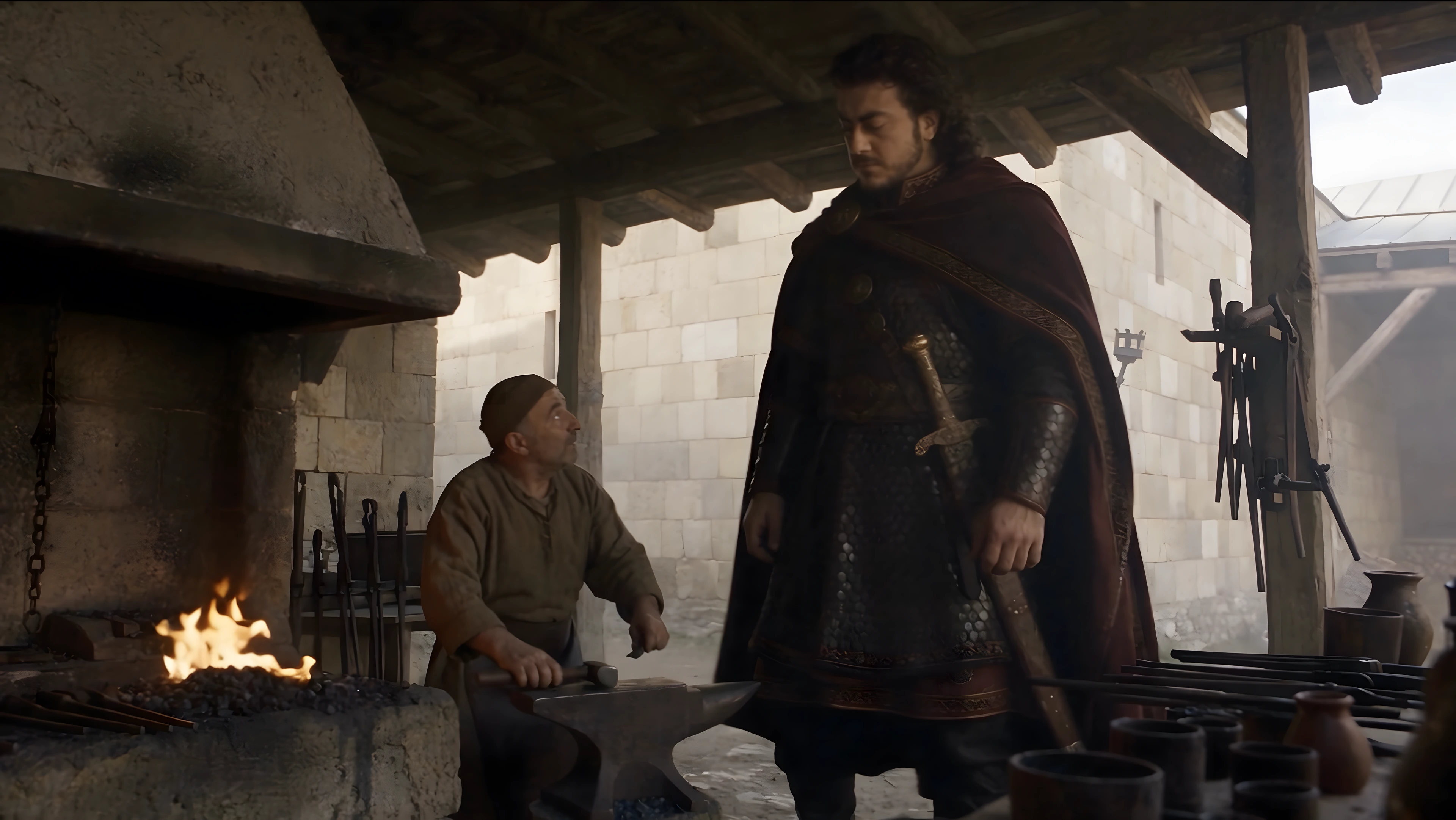
History, reimagined.
Vakhtang Gorgasali is a historical short film inspired by the life, chronicles, and enduring memory of the fifth-century King of Kartli. Against the pressure of the Sasanian Empire, it explores kingship, Christian faith, conflict, and the cost of resistance. Georgian male choral traditions meet contemporary UK drill and trap in a cinematic interpretation that brings an ancient figure into a modern musical language. Written, produced, and directed by Levani Shalolashvili, the film uses generative tools within a human-led creative process. It approaches its subject through history, tradition, and cultural memory rather than claiming to offer a complete literal biography.
History. Tradition.
Interpretation.
Vakhtang I, King of Kartli
Vakhtang I Gorgasali ruled Kartli in the second half of the fifth century. Kartli was a kingdom in the eastern part of what is now Georgia, situated between powerful neighbouring empires. His reign is remembered for efforts to strengthen the kingdom, defend its autonomy and resist Sasanian imperial pressure.
A political and military leader, Vakhtang also holds an important place in Georgia’s Christian history. Georgian chronicles associate his reign with church building, religious organisation and the consolidation of royal authority. His image has endured in historical writing, religious tradition and the cultural memory of Georgia.
Founder of Tbilisi
Vakhtang Gorgasali is remembered as the founder of Tbilisi, the capital of modern-day Georgia. Georgian tradition connects him with the city’s foundation and development, while its famous founding legend tells of a royal hunt and the discovery of warm springs. The name Tbilisi itself is associated with warmth.
The city’s earlier settlement history and the later traditions surrounding its foundation are distinct. Vakhtang’s lasting association with Tbilisi expresses his place in Georgia’s memory as a king who built as well as defended. This historical context does not imply that the film contains a founding-of-Tbilisi sequence.
The film’s interpretation
The film draws on history, chronicles, and enduring cultural memory. Its contemporary musical language frames themes of faith, leadership, and resistance; it does not claim to be a complete literal biography.
Levani Shalolashvili
Writer, producer and director of Vakhtang Gorgasali.
Creative intention
The film sets out to introduce audiences unfamiliar with Georgian history to Vakhtang Gorgasali through a form that feels culturally rooted and unmistakably contemporary. Generative filmmaking made a scale of period world-building possible within an independent, individual-led production.
Production approach
The film combines AI-generated imagery, video, music, and voice with human-led writing, direction, selection, and editing. Generative tools formed part of the production process; the film’s narrative structure and final assembly were shaped by the filmmaker.
Read about the creative process ↗