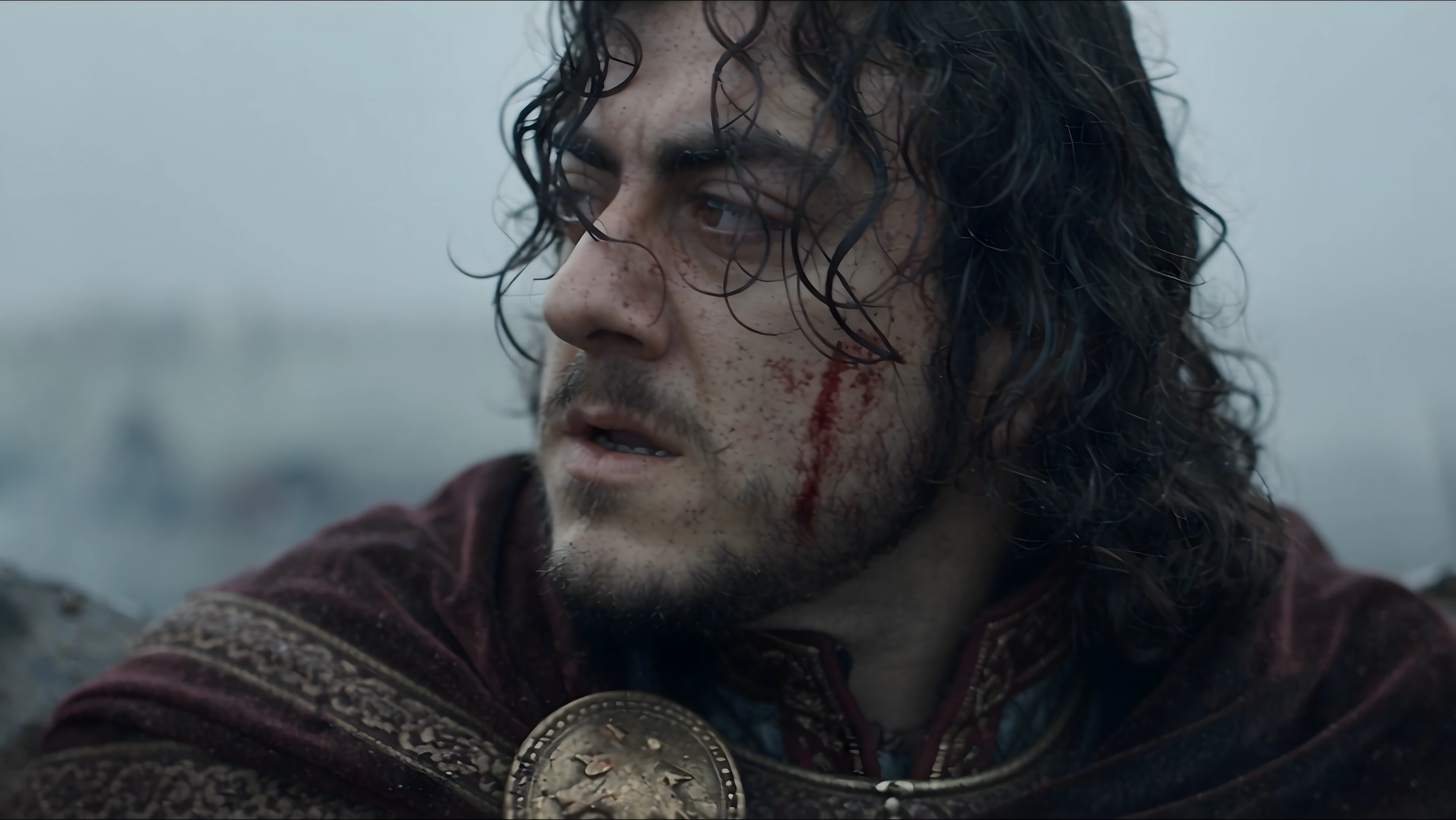
Making of / Production journal
From imagination
to the final frame.
The film combines AI-generated imagery, video, music, and voice with human-led writing, direction, selection, and editing. Generative tools formed part of the production process; the film’s narrative structure and final assembly were shaped by the filmmaker.
Creative approach
A historical world,
independently imagined.
The project began as an experiment in reconstructing a historical world that would ordinarily require actors, horses, armour, large locations, sets, stunt performers and extensive visual effects. Research into fifth-century Kartli, warfare, architecture, religion and Georgian representations of the king informed an artistic interpretation. The film’s contemporary musical language was conceived as a way to connect that history with an international audience.
A concept for live action
Vakhtang Gorgasali is a complete historical short and a cinematic concept for the filmmaker’s ambition to realise a large-scale live-action production. The aim is to develop its characters, historical world and visual language further, potentially as a feature film or television series. This is a creative ambition, rather than an announcement of a commissioned or financed production.
Character & continuity
One identity.
Across every frame.
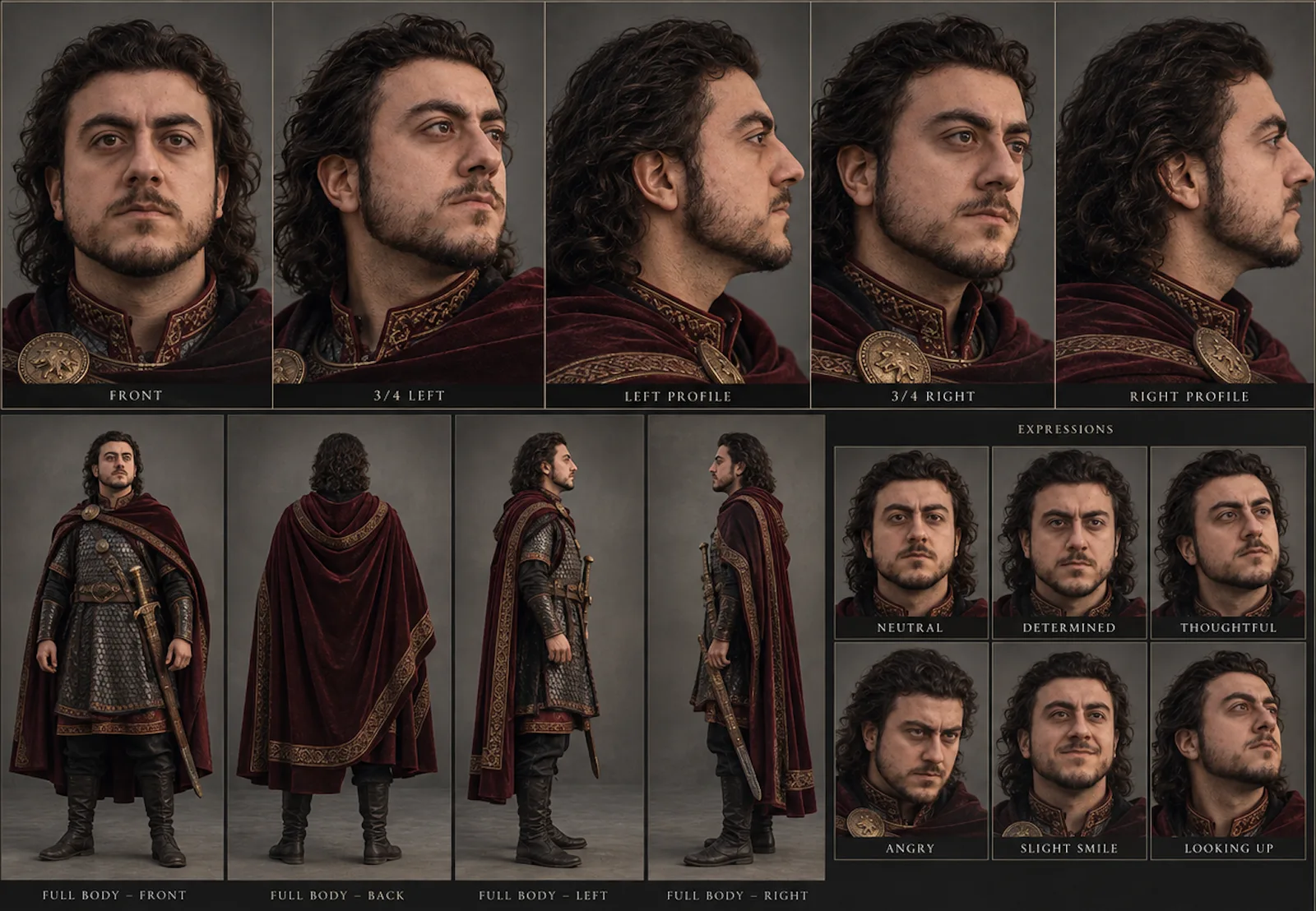
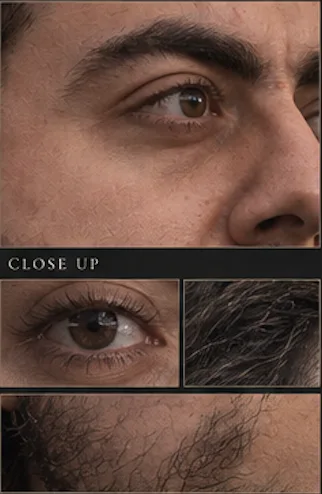
A recognizable visual identity was established before the principal moving-image sequences were produced. Reference imagery and Soul ID helped maintain facial continuity across close-ups, different camera angles, action and changing light. Outputs that drifted from the established appearance were reviewed, rejected and regenerated.
Why references matter
A reference image gives a generation a concrete visual starting point: facial structure, hair, costume, framing, light and environment can be judged against something visible rather than a description alone. A coherent character sheet also gives the filmmaker a shared standard when comparing shots.
What Soul ID contributes
Higgsfield Soul ID builds a reusable character identity from reference portraits. Clear images with varied angles and expressions help establish that identity. References and identity conditioning serve related purposes: a reference can guide a particular composition, while a reusable identity helps the same character remain recognizable across separate generations.
Continuity remains a filmmaking decision
Neither replaces continuity review. An unusual angle, changing light or an extreme expression can still introduce drift. Consistent facial identity does not automatically preserve armour, clothing, anatomy, action or the surrounding environment. Each of those needs to be checked as the shot moves into the edit.
Tools & their roles
The production toolkit.
Higgsfield was the platform used for the film’s image, character and video generation. Music, voice, development and editing had their own tools and distinct creative roles.
Higgsfield · Seedance 2.5
Primary video generation
Seedance 2.5, accessed through Higgsfield, was the principal model used to create the film’s moving-image sequences. Each scene was directed through visual and motion instructions covering character action, camera behaviour, environment, composition and dramatic purpose.
The film was built from individual sequences. Generations were reviewed separately; prompts and reference material were revised when the result failed to serve the intended shot. Selected sequences were then assembled in post-production.
Higgsfield · GPT Image 2
Image generation & visual development
GPT Image 2, accessed through Higgsfield, was used to develop characters, environments, compositions and still-image references. Decisions about costume, atmosphere, framing and character appearance could be established before moving-image generation.
These images provided controlled visual starting points for subsequent sequences, giving the filmmaker more specific material to direct and assess than text instructions alone.
Higgsfield · Soul ID
Character creation & identity consistency
Soul ID helped establish Vakhtang’s visual identity and reduce unwanted changes to his face across separately generated scenes. Reference material supported continuity as he appeared in close-ups, action, different environments, camera angles and lighting conditions.
The filmmaker still reviewed the outputs manually. Significant changes to the established appearance were grounds for rejecting and regenerating a sequence.
Suno AI
Music generation
Suno AI was used to generate the original music under human creative direction. Prompts and lyrical direction specified musical character, vocal style, tempo, instrumentation, dramatic intensity and the relationship between music and historical imagery.
The musical direction combines Georgian male choral elements with UK drill and trap. Outputs were evaluated, selected and placed in the edit according to the film’s pacing and narrative progression.
OpenAI · ChatGPT
Research, development & production assistance
ChatGPT supported historical research, scene concepts, shot planning, prompt construction and refinement, production problem-solving, Georgian-language review and development, music-prompt development and workflow organisation.
Its outputs were development material. The filmmaker reviewed, modified or rejected suggestions according to the project’s historical, narrative and visual requirements.
ElevenLabs
Generated voice-over
ElevenLabs generated spoken voice-over material. The filmmaker determined the written text, language, dramatic purpose, placement and intended emotional delivery.
Generated performances were evaluated for tone, pacing, pronunciation and dramatic suitability before being placed manually in relation to the imagery and music.
Filmora
Editing & final assembly
The selected material was manually assembled in Filmora. Editing established narrative order, shot duration, rhythm, transitions, sound placement and the film’s overall dramatic progression.
The generative systems produced source material; the filmmaker’s selection and editing shaped it into the completed work.
From research to final assembly
Eight stages.
One authored film.
Historical & visual research
Research established the political, religious and visual context of fifth-century Kartli, including warfare, clothing, armour and architecture.
Character development
Reference imagery and Soul ID established a recognizable Vakhtang before the principal moving-image sequences were produced.
Image & scene development
Still-image development defined framing, costume, atmosphere and environment before animation.
Shot design & prompt development
Each shot had a cinematic purpose. Instructions addressed camera movement, character positioning, physical action and transitions. Complex actions were broken into more controlled sequences.
Video generation
Generated sequences were assessed for identity, composition, physical plausibility, continuity and narrative usefulness. Failed shots were revised and regenerated.
Music development
Suno outputs were developed under musical and lyrical direction, then selected and positioned for the film’s dramatic progression.
Voice-over generation
ElevenLabs performances were reviewed for vocal character, pacing and pronunciation, then placed manually in the edit.
Editing & final assembly
Filmora brought the selected imagery, movement, music and voice together through deliberate choices about timing and narrative order.
Iteration & quality control
Generate. Review.
Make a choice.
Each sequence was judged for character consistency, physical plausibility, camera behaviour, composition and continuity. Complex movement involving horses, weapons or combat sometimes needed to be simplified or described more precisely before another generation. Visually convincing imagery alone was not enough: a shot had to work within the story.
What each shot was checked for
- Character and facial consistency
- Historical and visual suitability
- Anatomical and physical plausibility
- Character movement and interaction
- Weapon and combat behaviour
- Camera movement and composition
- Continuity with surrounding shots
- Lighting and environmental consistency
- Narrative usefulness
- Concept
- Generation
- Review
- Correction
- Regeneration
- Selection
- Edit
A generated shot was not automatically a finished shot. Final material was selected for its ability to serve the narrative as a whole.
Music direction · Suno AI
A Georgian voice.
A contemporary pulse.
Georgian male choral traditions anchor the soundtrack in the cultural identity of its subject.
UK drill and trap provide the contemporary counterpoint. Their heavy rhythmic structure, cinematic intensity and globally recognisable hip-hop vocabulary were used to give the historical narrative an immediate connection to modern audiences, particularly viewers who may have little previous knowledge of Georgian history.
Music therefore functions as more than accompaniment. It is part of the film’s approach to cultural translation, preserving a distinctly Georgian voice while presenting Vakhtang’s story through a contemporary form capable of reaching audiences beyond Georgia.
Georgian-language vocals, including invocations of Vakhtang and Gorgasali, connect the music to its subject. Prompts supplied to Suno defined musical structure, tempo, vocal character, choral elements and dramatic progression. The filmmaker selected and positioned the resulting music in relation to image and voice.
Production disclosure
Creative responsibility.
Human-led decisions
- Concept, research and narrative development
- Character direction, shot design and composition
- Prompt development and action direction
- Evaluation, selection and rejection of generations
- Music direction, editing and pacing
- Sound placement, final assembly and creative decisions
Generative contributions
- Character and visual development
- Still-image generation
- Assistance with identity consistency
- Moving-image generation
- Music and voice-over generation
- Research and creative-development assistance
Conventionally sourced material
The production journal records one commercially licensed iStock photograph among the film’s materials. It is not AI-generated. Its source file and licensing records are not redistributed through this website.
The final work
The film was constructed from individually directed and selected sequences, then manually assembled in Filmora. Editing determined narrative order, shot duration, rhythm, transitions, voice placement and the relationship between music and image. Generative systems supplied production material; the filmmaker shaped the final work.
The narrative structure, historical interpretation, visual direction, sequence selection, pacing and final assembly remained under the creative control of Levani Shalolashvili.
The ambition for a live-action production ↗The creative vision